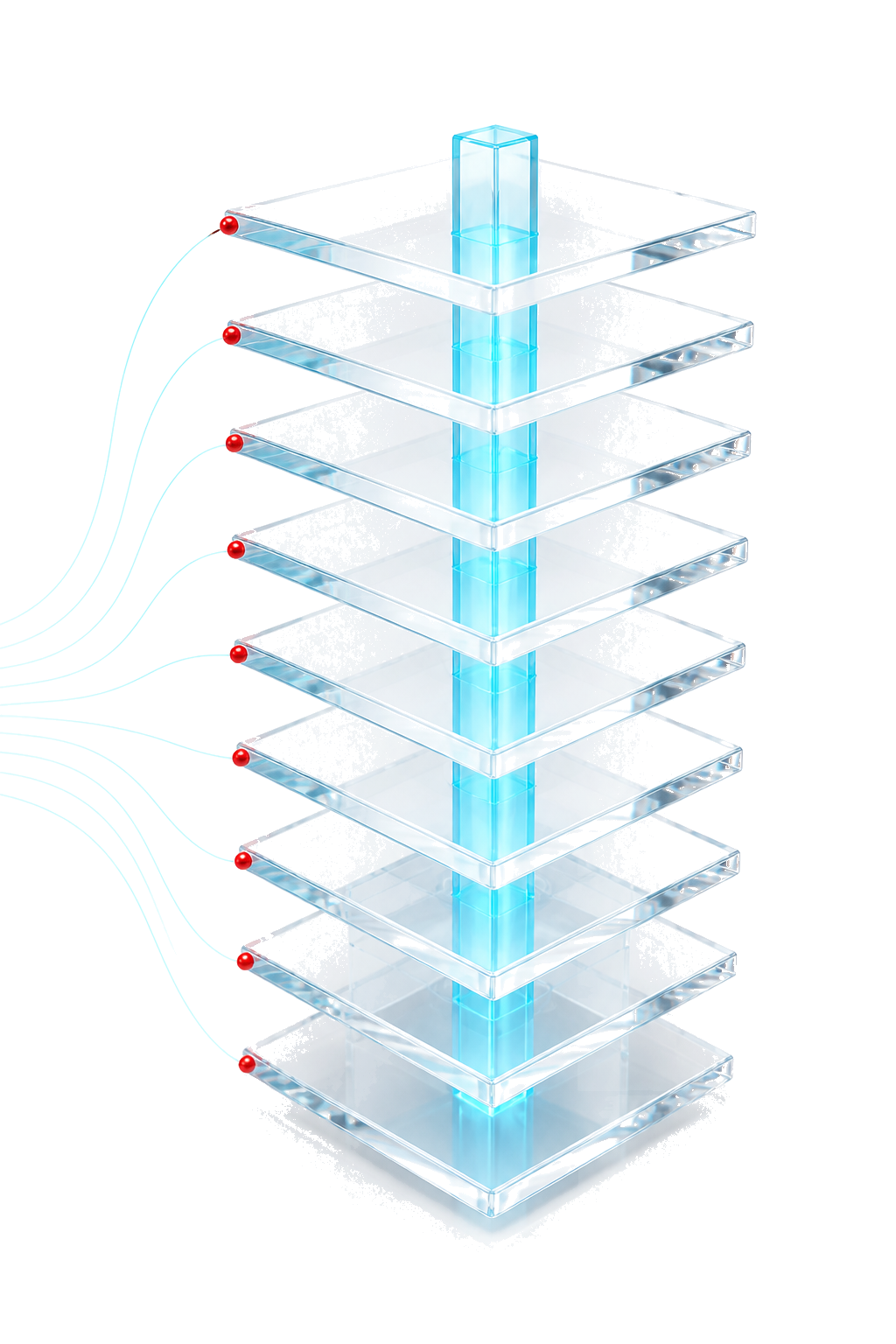
Business strategy
Leadership ambition, portfolio priorities and value realisation define where AI effort should concentrate.
Loading page
Loading pageAI Centre of Excellence
Agrayian helps organisations design and stand up AI Centres of Excellence that connect strategy, governance, platforms, talent and delivery — so use cases stop restarting from zero.
CoE operating stack
Scroll to see how strategy, control, delivery and value realisation connect — or browse the full stack below.
Leadership ambition, portfolio priorities and value realisation define where AI effort should concentrate.
Risk tiers, intake, approval gates and assurance evidence keep innovation aligned with accountability.
Structured intake, scoring and prioritisation protect capacity and force early clarity on value and feasibility.
Governed data products, access patterns and quality rules underpin every production AI system.
Shared model access, retrieval, evaluation harnesses and component registries reduce one-off engineering.
Reusable playbooks, squads and release discipline turn approved demand into production capability.
Clear roles, enablement and federated competence multiply scarce specialists across the organisation.
Production observation for drift, misuse, fairness signals and control failures with defined incident paths.
Outcome, adoption and control measures designed per use case — not claimed after go-live.
Definition
An AI CoE is not a slide deck or a tool catalogue. It is the organisational system that decides what gets built, how it is governed, which platforms are reused, who owns outcomes and how value is evidenced.
Why it matters
Without a CoE, AI investment fragments into disconnected experiments. With one, leadership gains a governed pathway from ambition to production outcomes.
AI initiatives sit across IT, analytics, digital and business units with no shared intake, standards or accountability model.
Successful demos rarely convert into production systems because delivery patterns, data access and governance are reinvented each time.
Some teams over-engineer controls while others ship ungoverned tools, creating inconsistency that boards and regulators notice.
Prompts, components, evaluation methods and integrations remain local knowledge instead of becoming enterprise assets.
Delivery friction
Most AI programmes stall for operational reasons, not model novelty. The CoE exists to remove these recurring failure modes.
Framework
Nine interconnected pillars grouped by how they steer investment, assure outcomes and industrialise delivery.
Business strategy, portfolio priorities and value realisation set where AI effort should concentrate.
AI governance, data foundations and monitoring ensure systems remain safe, auditable and operable.
Platform, delivery factory and talent systems turn approved demand into reusable production capability.
Operating models
There is no single correct structure. Agrayian helps you choose and operationalise the model that matches maturity, risk posture and delivery capacity.
The CoE runs shared platforms, governance and high-complexity delivery, while federated teams execute approved patterns for lower-risk work.
Most mid-to-large organisations seeking durable scale without losing oversight.
Accountability
Clear forums and roles prevent AI from becoming either unowned experimentation or process theatre.
Sets ambition, funding rules, risk appetite and portfolio priorities. Reviews value realisation and material escalations.
Owns operating model, standards, platform roadmap, enablement and delivery factory performance.
Assesses risk-tiered use cases, approves high-impact systems, and oversees policy exceptions and incident themes.
Sponsor use cases, define outcomes, accept releases and retain accountability for business decisions supported by AI.
Risk, compliance, legal, security, privacy and audit embed proportionate controls into intake, build and monitoring.
Portfolio
A disciplined intake process protects scarce capacity and forces early clarity on value, feasibility and risk.
Structured intake covering problem statement, users, data sources, decision impact and proposed outcome measures.
Evaluate value, feasibility, data readiness, strategic fit and risk tier using a shared scoring model.
Route quick wins, platform-dependent work and high-risk cases to the right delivery path and assurance depth.
Portfolio forum approves, defers or declines with clear rationale, dependencies and success criteria.
Delivery
The delivery factory turns approved demand into production systems through shared methods, squads and release discipline.
Foundations
Reusable services and patterns reduce one-off engineering and keep governance controls consistent across use cases.
People
An AI CoE succeeds when scarce specialists are multiplied through clear roles, enablement and federated competence.
Outcome ownership, sequencing and stakeholder alignment.
Model development, evaluation, grounding and system integration.
Reliable pipelines, access patterns and production foundations.
Risk classification, policy controls, assurance evidence and audits.
Bridge business process reality with technical design choices.
Upskill federated teams on approved patterns and tools.
Measurement
Value is designed into the portfolio, not claimed after the fact. Each use case needs outcome, adoption and control measures before build begins.
Decision quality, cycle time, exception closure, service coverage or cost-to-serve — defined per use case before build.
Active users, workflow completion rates and human override patterns that reveal whether the system is trusted in practice.
Assessment completion, monitoring coverage, incident closure and audit-evidence readiness across the portfolio.
Shared components consumed, patterns certified and time saved versus greenfield delivery.
Maturity
Agrayian uses a five-stage maturity curve to locate current capability and sequence the next practical leap — without forcing premature scale.
Stage 1
Isolated pilots and tool experiments with limited shared standards.
Stage 2
Early portfolio view, initial governance and selective production use cases.
Stage 3
Defined CoE practices, reusable platforms and formal risk controls.
Stage 4
Repeatable delivery factory, broad adoption and measured benefits.
Stage 5
Continuous improvement, strong assurance and adaptive operating models.
Roadmap
A practical sequence from diagnosis to a scaled operating model, adapted to your current maturity and constraints.
Understand maturity, demand and constraints.
Deliverable: CoE readiness assessment
Define the target operating model.
Deliverable: CoE target design pack
Stand up the first operating rhythm.
Deliverable: Working CoE cadence
Make delivery and reuse repeatable.
Deliverable: Reusable delivery system
Expand portfolio impact with control.
Deliverable: Scaled CoE operating model
Engage
Start with diagnosis, design a durable CoE, or partner through factory and platform build-out.
A focused assessment of maturity, operating gaps, portfolio readiness and recommended sequencing.
Operating-model design, governance forums, intake process, playbooks and mobilisation support.
Build the methods, squads, evaluation practices and release controls that turn approved use cases into production systems.
Ongoing support for reusable platform components, assurance evidence and portfolio performance.